

No one will ever accuse me of not heeding the call to action or walking away from a challenge. My exploratory process regarding the The Montreal Expos revival, aka project Peanut, started off thinking this was 1% likely, but after a week where media and fans expressed more enthusiasm than I could have expected, and listening to investors who look for such opportunities, I would put it at (again subject to MLB granting us an expansion team and me patiently following the process) at 25-49%. The government’s support in the “Montreal Mojo” 4C – cultural, creative, commercial centre – is now the next question to determine (sondage/survey ready for feedback).
First, a table outlining the vision and strategy:

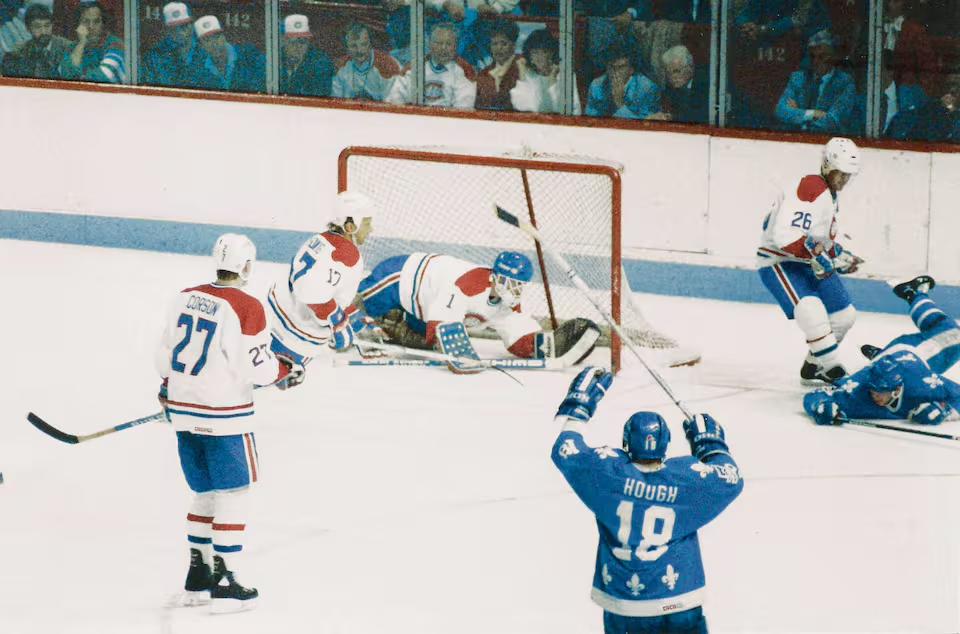
The Nordiques’ faithful asked for my thoughts on their return, and I think the issues are three-pronged:
1) structural economic conditions: small population, relatively weak corporate base, city does not help NHL negotiate better US TV rights’ deals (quick analysis here).
2) NHL actual priorities: understandably, Gary Bettman is prioritizing Atlanta, Houston, whose large populations would give the league a better hand with broadcasters, streamers.
3) People and psychology: with the Expos, I think false modesty aside, I have demonstrated in one week to the many stakeholders that I would be willing to lead this effort AND deliver the goods, especially given that others seem to have grown exasperated, and asking a person/family/company to do it alone is unreasonable.
With the Nordiques, it’s a different matter altogether (and if this were a case study in The Academy School of Entrepreneurship, I would give a lower grade to anyone who overlooks the following, since to succeed in life and in business, you must master humanities.
People Matters, Part I
Any Québec NHL roadmap begins with people, not paperwork.
Aside from being a Montreal Canadiens fan, the reality is that in the near-term, micro-sense, the Canadiens do not benefit at all by having a second team in Quebec.
From a business sense, if Habs’ owner Geoff Molson asked me “some guy is stirring the pot telling Quebec city fans they may get their team back… aside from being a nuisance, what the hell am I supposed to say to that?”
To be intellectually honest, I would tell him that on the one hand, he has “no excuses to make” if he didn’t exactly love the notion, adding, it certainly is to the benefit of Quebecers if there was one solid team (on the ice and financially) representing the province… and indeed, a second team would possibly eat into margins, revenues, etc… though we both would agree that demand for season tickets would not feel a dent, nor would sales of corporate suites and even audience.
But, as I do when I advise CEOs and investors globally, I always start with WHY. What do you want your legacy to be when said and done. Montreal’s dominance means a Quebec City team has limited negative commercial impact, but it does create narrative and historical implications; depending on his goals, I would either encourage the idea or talk him out of it. If his ambition is to elevate the Canadiens from a proud regional powerhouse to a truly global sports brand – not just the saviour of the Habs carrying on a family legacy, but one of the greatest governors of his era – then I would say that giving up a little bit of the province of Quebec to set his sights on global goodwill, merchandise sales, non-domestic streaming audience development, and so on will be one of the few, realistic ways that he can continue to grow the value of the organization, which has soared from CAD$600M when purchasing it, to an estimated US$3.4B+ in CNBC’s recent 2025 report. And yes, I would gladly make available WatchMojo’s global editions (9M subscribers on WM LATAM, additional 10M across EU, Asia, Middle East, Australia, for 50M in all excluding our additional reach on TikTok, Instagram, Snap, MSN, Amazon, etc) and reach to help the Canadiens become the international hockey brand, competing culturally with franchises like the Cowboys, Yankees, Lakers, Barça, and beyond and while not necessarily leapfrog the NY Rangers, at least rival and surpass the value of the Toronto Maple Leafs. Local rivalries create greater interest but the benefits largely flow to the dominant teams in any sports (FC Barcelona does not suffer from Espanyol, neither does Real Madrid because Atletico Madrid exists; Rangers vs Islanders in hockey, etc).
The delta in value in 20 years is considerable.
Wild Card: WatchMojo’s Technology Platform
I now also see our tech platform Unity as an incredible ace to use with sports leagues – Major League Baseball actually developed MLB Advanced Media (MLBAM), a groundbreaking venture by MLB team owners to develop their own digital platform, which ultimately led to the creation of the highly successful MLB.TV streaming service. Many do not know this, but MLBAM’s technology arm was spun off and eventually acquired by Disney in a deal that created the foundation for their own streaming efforts (ESPN+ and Disney+).
Unity becomes a proxy and tool between sports fan engagement and “creator economy,” a massive, rapidly growing market, valued at over $200 billion in 2024 and projected to exceed $1 trillion by the early 2030s, with some forecasts hitting nearly $1.4 trillion, driven by monetization tools, social media, and brand sponsorships, with North America leading but Asia-Pacific growing fastest. Key growth areas include video, photography, subscriptions, and brand partnerships, making it a significant economic force. This is one of the things I plan to showcase to MLB to entice them to grant Montreal the first of two expansion teams sooner than later (so I can then shift my sights on the “Montreal Mojo” C4 civic development plan). The bottom line: Any league that controls our tech platform would then have a pole position and capture other sports teams and leagues’ deployment for fan engagement.
The best thing in media in 2025 is to own YouTube, but Google owns it. The second best thing for pro sports teams is to control the platform that helped WatchMojo scale production, publishing, syndication – and apply it to user generated content.
People Matters, part II
On the other side, Quebecor owner Pierre Karl Peladeau to me is a brilliant operator and visionary who saw where the puck was headed when he transformed Quebecor (the company his father Pierre Peladeau founded) by acquiring Videotron and creating one of – if not the best examples and execution of synergy within a market. As language is the foundation of any society and culture, it’s not surprising for someone like me – a proud Canadian who arrived at 6 and grew up in the French system and fluent in Quebecois Français or Parisien French by virtue of my academic track record – why many Quebecois including PKP would be separatists. But, this – combined with PKP’s reputation (only an issue in Quebec where ambition and drive are seen as bad traits) – this creates an obstacle akin to an elephant in the room. To discuss le retour des Nordiques without touching on this point would again dock points from any assignment at The Academy… so while until the fans’ requested I did not even think of this, it is certainly plausible that in one scenario not expected but not impossible, we could align on our strengths and reach a practical compromise:
- Mr Peladeau gets to operate “his” team — he owns the arena, has the local rights and personnel — while
- while really not seeking this opportunity otherwise, if I can serve as the diplomatic liaison with the NHL, providing the temperament, neutrality, and global perspective required for Board approval, then I would at least consider it as we plan for Granicus Sports & Entertainment.
Before anyone accuses me of trying to throw myself in the mix, I never sought attention… and the simpler thing would be to do nothing, or at most, just work with a sports team-focused PE firm and buy one (1) team (personal preference, somewhere warm). But, purpose matters and saying you put principles above all means looking at the larger picture.
Ultimately, for the Nordiques to return, Montreal must be strong, the province must be aligned, and the NHL must first exhaust its U.S. priorities — unless I can assemble a sufficiently compelling “package” that reframes Québec not as a nostalgic return, but as a strategic asset for the league’s future:
– Unity as a digital modernization layer (fully expecting them to want equity in it, which I am fine with),
– WatchMojo as a global distribution engine,
– unified ad sales opportunities (whereby the league and or teams can sell our ad inventory),
– and even long-term equity participation in WatchMojo and/or Granicus Group for teams (because as one of my advisors reminds me: equity aligns people). If you think about it, YouTube’s golden era is about to commence. Inasmuch as the value of cable powerhouses ESPN and MTV soared after their acquisitions by Disney and Viacom, WatchMojo’s value will soar in the decade to come. I have zero issues leveraging the goodwill of our equity if it means joy and happiness to an entire province.
Done right, Montreal wins, Quebec wins, and the league wins — a rising tide that lifts every boat.
Do I expect any of this to happen? We shall see.
WRT Funding – a quick update & confirmation!
Earlier this week, when I granted interviews, the honest truth is that in my head I thought the probability of securing meaningful capital was roughly 80% (I’m a conservative person, folks, so interpret that as you desire). But publicly, the responsible answer was: “It’s 50–50 — maybe 51% rather than 49%.”
Not out of false modesty, but out of realism: nothing is real until capital is committed, and every corp dev process is three-pronged: Interest, Intent, Action.
Now, only a few days later, after conversations as a result of my exploratory process with institutional investors, family offices, and fund managers — all of whom are simply doing their job to email me and inquire about my plans — the picture has changed. Internally, the likelihood feels closer to 80–90% (with the usual caveat: nothing is done until the cash is in the bank). Publicly, the right framing remains closer to “66% likely.” And when I’m 99% sure, when we’re just waiting for funds to clear, I will still tell people “75% likely.” That’s how this world works.
What this week has made unmistakably clear is this: capital is not the constraint. In fact, capital is readily available. The real constraint — the real challenge — sits elsewhere.
“Too Many Cooks, No Real Chief”
MLB left Montréal in 2004 with a bad taste in its mouth: the Brochu saga, a dozen fractured LPs, no alignment, and no unified long-term vision (see our breakdown of who was to blame on Inside Expos Part I, with Part II this week recapping how this all came together in a few days). And though I’m speculating, it’s obvious to anyone who understands sports that the 2024 Tampa Bay Rays split-season proposal was DOA. Players would never accept it. Any sane league would recognize it as a recipe for disaster. And any credible proposal for Montréal must be BASEBALL-first, not a real estate play that uses baseball as a sideshow.
But here’s what has surprised me — pleasantly. The more conversations I’ve had, the more I’ve realized that investors aren’t just looking to deploy capital. They’re looking for someone credible, serious, and capable. Someone bilingual. Someone who understands the province’s distinct reality and can thread the needle between Québec, Ottawa, MLB, and the broader fan base. And in those conversations, the message has been consistent: “We’ve been waiting for someone to step up with clarity, purpose, and a plan.”
So, one week after I sprung into action, this is the plan — and the momentum is real. The question is, can I demonstrate the patience required to pull it off. Just watch!




6 Pingbacks