

A few days ago, my board member and long-time industry friend Peter Horan sent me a link to a Business Insider article about MrBeast’s burger venture imploding, with a one-line comment: “Over-extension.”
The old me would probably have overthought it — reading between lines that weren’t there, wondering if this was a gentle nudge about over-extending… myself. These days, I’m far more comfortable in my own skin and in trusting my instincts. Still, as any reasonably coachable entrepreneur would, I asked him directly whether my parallel efforts — from bringing back the Expos, to helping free Iran, to dabbling in music albums and a slate of scripted projects (more to come)— were what he had in mind.
“Only with respect to MrBeast,” he replied. “I don’t do hidden meanings.”
Still, I thought, that is the difference between entrepreneurs and executives/investors/advisors.
We live in a world that still rewards — or at least appears to reward — linear focus. One company. One lane. One identity. Deviate from that, and people reach for words like “distraction,” “overreach,” or yes, “over-extension.”
But here’s the thing: what looks like sprawl from the outside often looks very different from the inside.
The difference between distraction and optionality
At WatchMojo, the core business runs. The team executes. We remain profitable and relevant — largely due to operational excellence, not because the underlying offering is suddenly more “sexy” than it was a decade ago. The format was brilliant in 2013–2016. Today, it’s mature. We have continued to reinvent ourselves, entering the third stage of growth in our 20-year history. Most companies decline after they mature and die.
That maturity creates a paradox: stability, but also constraint.
The parallel initiatives I’m exploring are not meant to be iterative distractions that demand prolonged operational focus. They are shots on goal. If even one connects meaningfully, the upside is asymmetric. The downside, by contrast, is limited — especially when leverage (people, tools, AI, networks) compresses time and cognitive load.
In other words: this isn’t about doing everything. It’s about increasing the surface area for something to break through.
Why this isn’t MrBeast (and that’s not a knock)
The MrBeast burger saga is a cautionary tale — but not because ambition is bad. It’s because operational entanglement, brand dilution, and misaligned incentives can quietly compound until they snap.
That’s not what’s happening here.
What I’m doing is closer to strategic amplification than over-extension:
- Expos isn’t “sports for sport’s sake” — it’s civic, cultural, and long-term asset building.
- ARYA isn’t a vanity music project — it’s cultural translation and soft power.
- Iran advocacy isn’t performative outrage — it’s values with consequence.
- Investing and the slate aren’t distractions — they’re optionality engines.
Each feeds conversations, relationships, credibility, and inbound opportunities that the core WatchMojo business, by itself, no longer generates at scale.
The Elon Musk comparison (and why I half-agree with the skeptics)
People often say, “I don’t understand how Elon does ten things at once.”
Honestly? Neither do I — at least not mechanically.
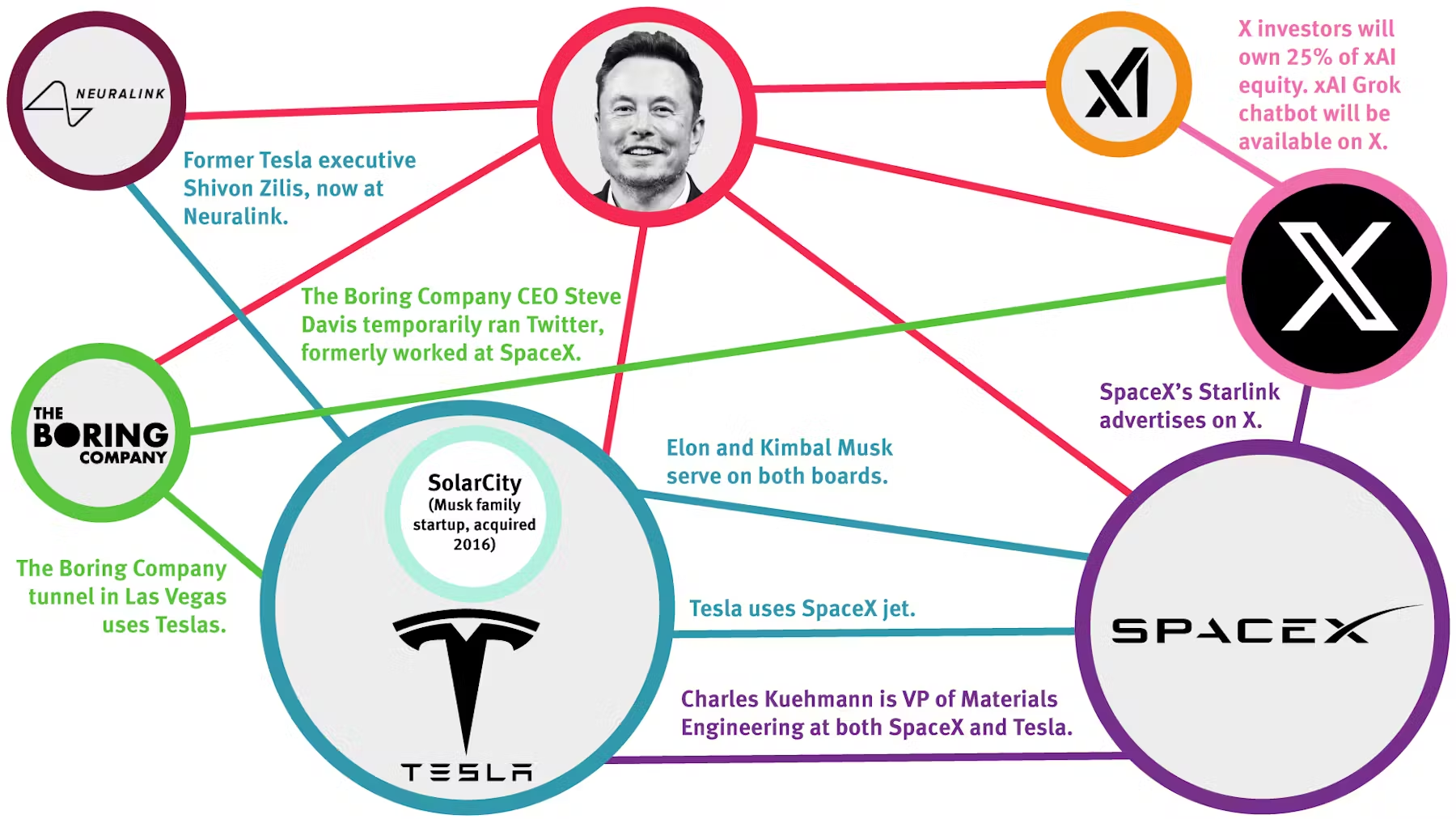
I don’t pretend to understand how one human physically arbitrates Tesla, SpaceX, Neuralink, X, and everything else at a day-to-day level. What I do understand is the why and the how at a systems level: delegation, leverage, first-principles thinking, and a willingness to look irrational before results show up.
That’s the method to the madness.
I’m not Elon. I’m also not trying to be. But the principle holds: range is not the enemy of focus if there is a coherent underlying logic.
The real risk — and the real discipline
The actual risk here isn’t execution. It’s optics.
Some investors and institutions are comforted by single-thread narratives. Multiple vectors make them uneasy. That’s not irrational — it’s human.
The discipline, then, isn’t to narrow the work. It’s to frame it properly, sequence it intelligently, and remain brutally honest about where attention is truly required versus where optionality can sit patiently.
That’s a skill. One I’ve learned the hard way.
Over-extension, or something else?
If this were chaos, it would show up in missed execution, abandoned projects, or confused teams. What I see instead is coherence: one operating system applied across different domains.
So yes — from the outside, it may look like too much.
From the inside, it feels like a second act with intent.
And if the choice is between playing it safe in a lane I’ve already mastered, or expanding the field of possibility while I still have the energy, conviction, and appetite for risk — I know which one I’ll choose.
Every time.




Leave a Reply